
What Is the 3 2 1 Rule For Haircuts?
November 10, 2025
If you’ve ever wondered how barbers manage to create those crisp fades that look smooth from every angle, there’s a good chance the secret lies in one simple method: the 3-2-1 rule.
To the untrained ear, it sounds like a countdown. But in the grooming world, these three numbers represent one of the most reliable, beginner-friendly, and professional haircut techniques ever used.
Whether you’re new to understanding clipper guards, tired of uneven fades, or simply want to walk into a barbershop in Riverbend North knowing exactly what to ask for, this guide will break down the 3-2-1 rule with clarity, detail, and plenty of real-world context.
And if you want this cut done right? Locals already know where to go — Number One Barber Shop. Let’s dive in.
Understanding the Basics of the 3-2-1 Rule
At its core, the 3-2-1 rule uses three clipper guard lengths — #3, #2, and #1 — applied in descending order from top to bottom along the sides and back of the head. Think of it as a “ladder fade,” where each step creates a clean, predictable transition between lengths.
It’s simple, structured, and highly effective.
But don’t mistake simple for basic — even the most seasoned barbers rely on the rule because it makes every fade smoother, cleaner, and more consistent.
Why It Matters
Imagine painting a wall. If you start with a dark color and suddenly jump to a very light color without blending in between, the result looks jarring. Hair works the same way.
The 3-2-1 rule:
- Eliminates harsh lines
- Prevents accidental patches
- Ensures smooth gradients
- Helps barbers move with precision
- Makes the end result look naturally blended
For the client, this rule means fewer surprises. When your barber follows this method, you get a haircut that looks sharp from day one through the following weeks — because the fade grows out evenly, too.

The Origins of the 3-2-1 Rule
The 3-2-1 rule didn’t appear out of nowhere. It emerged as barbers began refining fade techniques to make them simpler to teach and easier to master. Before modern guard systems existed, barbers relied heavily on scissor-over-comb methods that required years of training.
Clippers changed everything — but so did consistency.
To avoid guesswork, barbers developed universal patterns. These patterns evolved into simple sequences like 4-3-2, 3-2-1, or 5-4-3. Among them, the 3-2-1 rule became the most popular because it works well on nearly any haircut style and hair type.
Barbershop Insights
Talk to any experienced barber, especially those who have been cutting hair for decades, and you’ll hear a similar story:
“Once you master the 3-2-1 fade, everything else becomes easier.”
It’s the foundation for:
- Modern fades
- Military-style cuts
- Classic tapers
- Crew cuts
- Undercut blends
In shops like Number One Barber Shop in Riverbend North, it’s practically a universal language among barbers. One barber can pick up where another left off simply by knowing the guard sequence used.
Breaking Down the 3-2-1 Rule
Let’s take a closer look at each step of this technique and how it shapes the final haircut.
Step 1: The “3” – Achieving the Longest Guard Length
The process begins with the #3 guard (usually around 10 mm or 3/8 of an inch). This sets the longest layer on the sides and back.
Think of it as laying the foundation to build a smooth fade. Without a good foundation, everything above it — the taper, the transitions, the blending — will struggle.
Ideal Areas for the #3 Guard
Barbers typically use the #3:
- From the mid-sides up to just below the parietal ridge
- Upper back portion
- Areas where you want some fullness without letting the hair puff out
- For men with thicker, wavier hair to prevent bulk
The #3 guard length is perfect for clients who want a clean, well-groomed look without going too short.
It’s ideal for:
- Professionals
- Students
- Anyone needing a neat style that’s easy to maintain
Step 2: The “2” – Creating a Medium Transition
After establishing the #3 area, the barber moves down to a #2 guard (about 6 mm). This is where the fade starts to form, and the haircut begins showing its shape.
A #2 is noticeably shorter but not aggressively so. It starts the transition from long to short in a way that’s still gentle on the eye.
Smoothing Out the Fade
The #2 guard is responsible for:
- Removing weight under the #3 area
- Creating a naturally tapered look
- Narrowing the sides for a more sculpted appearance
- Helping the haircut contour to the shape of the head
The #2 step is crucial. Without it, the fade will look too stark or too blocky. With it, the haircut looks intentional — like the difference between a rough sketch and clean linework.
Step 3: The “1” – The Tightest and Cleanest Finish
The final step involves the #1 guard (around 3 mm). This is where the fade gets its sharp, tight, professional finish.
This guard creates the lowest and shortest part of the fade, usually near:
- The ears
- The neckline
- The bottom third of the sides
How Barbers Use the #1 Guard for Precision
Experienced barbers use the #1 guard like a sculpting tool. It adds contrast and definition, similar to how bold outlines bring a drawing to life.
A #1 at the bottom does several things:
- Makes the fade look cleaner
- Sharpens the haircut’s silhouette
- Keeps the sides from puffing out as hair grows
- Ensures the haircut lasts longer before looking shaggy
In many modern men’s hairstyles, the #1 is the “signature move” that gives barbershop haircuts their fresh, polished look.
Why the 3-2-1 Rule Works So Well
You might wonder why this specific pattern is so widely used. The answer lies in both logic and aesthetics.
Consistency Across Hair Types
Different hair types react differently to clippers, but the 3-2-1 method works across the board:
- Straight hair: Creates clean lines without revealing scalp too aggressively
- Wavy hair: Controls bulk while keeping texture
- Curly hair: Offers definition without creating harsh contrasts
- Coarse hair: Helps maintain structure and keeps the sides manageable
It’s a “safe bet” haircut method — dependable, predictable, and universally flattering.
A Foolproof System for Beginners
New barbers often struggle with blending. The 3-2-1 rule gives them a roadmap.
Instead of guessing:
- They follow guard order
- Blend between each step
- Build consistency in muscle memory
- Produce professional results faster
Even DIY haircutters benefit from this method since it reduces the risk of mistakes like uneven sides or unintentional bald spots.
Who Should Ask for a 3-2-1 Haircut?
While the 3-2-1 rule works on many people, some clients benefit from it more than others.
Best Face Shapes
The gradual fade created by the 3-2-1 rule enhances:
- Oval faces: Keeps proportions balanced
- Round faces: Adds verticality and creates slimming angles
- Square faces: Softens sharp edges without removing definition
- Diamond faces: Balances wider cheekbones
The fade subtly shapes the face, acting like contour makeup — but for men.
Best Hair Textures
This haircut is especially great for:
- Straight hair – avoids the “bowl” effect
- Wavy hair – enhances natural movement
- Coarse or thick hair – reduces bulk and heat
- Loose curls – keeps the sides controlled and structured
Even clients with very curly or Afro-textured hair can get a modified version using intermediate guard lengths.
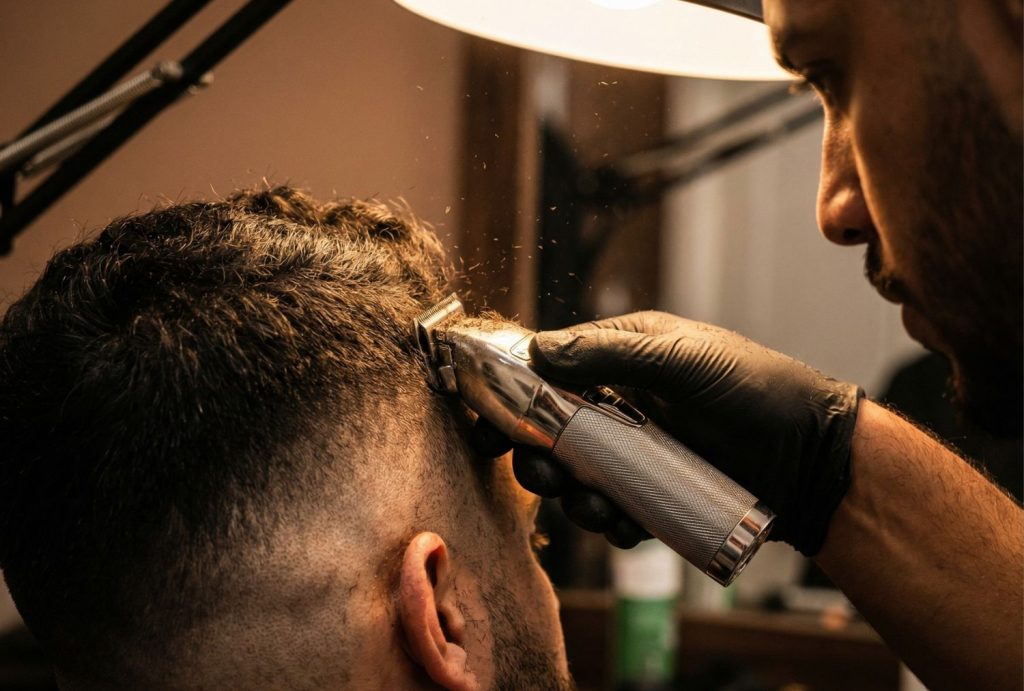
Common Mistakes When Using the 3-2-1 Rule
Even with a simple system, certain mistakes can ruin the final result.
Skipping the Blending Process
The guards create lengths — but blending creates beauty.
Without proper blending:
- Fade lines become harsh
- The haircut looks “stepped”
- Transitions appear abrupt
Experienced barbers use flick-out motions and guard adjustments to soften the steps between lengths.
Using the Wrong Guard Sequence
Some inexperienced barbers jump from #3 to #1 using only clipper angles. That rarely ends well.
Following the 3 → 2 → 1 sequence ensures:
- No gaps
- No uneven patches
- No accidental zero fades
It’s a roadmap for a reason — stick with it.
Variations of the 3-2-1 Haircut
Once barbers master the 3-2-1 technique, they adapt it into different fade styles.
Low Fade 3-2-1
Perfect for a more conservative, subtle look. The #1 stays low around the ears and neckline, making the fade look soft and professional.
Mid Fade 3-2-1
The most versatile version. Works well with nearly all face shapes and hairstyles, from textured crops to quiffs.
High Fade 3-2-1
Bold, sharp, and edgy. The #1 guard goes higher, creating clear contrast. Great for athletic cuts, modern styles, and strong jawlines.
Styling a 3-2-1 Haircut
The fade is only half the story — styling makes the haircut come alive.
Recommended Products
- Matte clay: Natural finish, ideal for textured styles
- Pomade: Sleek and shiny look for classic styles
- Sea-salt spray: Great for wavy or messy-volume hairstyles
- Light-hold gel: Perfect for clean, structured looks
Daily Styling Tips
For best results:
- Apply products when hair is slightly damp
- Use fingers for casual styles and combs for formal ones
- Avoid heavy waxes that can weigh the fade down
- Refresh the fade with a quick neckline clean-up every 7–10 days
Maintenance Schedule: How Often to Revisit Your Barber
The 2–4 Week Rule
Because fades grow out quickly, barbers recommend returning for a touch-up:
- Every 2 weeks for a super sharp look
- Every 3 weeks for moderate maintenance
- Every 4 weeks for budget-friendly upkeep
A 3-2-1 fade grows out evenly, making it look good even in the final week before your next appointment.
Why Riverbend North Trusts Number One Barber Shop for the 3-2-1 Cut
When it comes to fades, experience matters. And in Riverbend North, Number One Barber Shop is the go-to spot for anyone who wants their 3-2-1 fade done right.
Expertise, Precision & Local Reputation
Clients trust Number One Barber Shop because:
- The barbers understand head shapes
- They tailor fades to hair type, lifestyle, and personal style
- Every cut is blended with precision and artistry
- Locals consistently recommend them for clean fades and modern cuts
Whether you’re getting your first fade or your fiftieth, this barbershop ensures you walk out feeling confident, polished, and camera-ready.
Number One Barber Shop Serving the Riverbend North Community and Beyond in Stafford
Number One Barber Shop is dedicated to serving the diverse needs of the local community of Stafford, including individuals residing in neighborhoods like Riverbend North. With its convenient location near landmarks such as the Oyster Point Park and major intersections like Nails Creek Dr and 3 Rivers Dr (coordinates: 29.60649556682946, -95.5876442007477), we offer walk-in barber shops services.
Get Walk-In Barber Shop Services at Riverbend North Now
Navigate from Riverbend North to Number One Barber Shop Now
Conclusion
The 3-2-1 rule for haircuts isn’t just a sequence — it’s a proven system for achieving clean, blended, professional-looking fades. With guard lengths #3, #2, and #1 used in strategic order, barbers can create smooth transitions that flatter most face shapes and hair textures.
And if you want a perfect version of this haircut? Visit Number One Barber Shop in Riverbend North, where skilled barbers elevate this simple rule into a signature style tailored specifically for you.
FAQs
1. Is the 3-2-1 rule beginner-friendly?
Yes — it’s one of the easiest fade techniques for new barbers and DIY users.
2. Can I combine the 3-2-1 rule with beard fading?
Absolutely. Many barbers extend the fade into the beard for a cohesive look.
3. What hairstyles work well with a 3-2-1 fade?
Buzz cuts, textured crops, quiffs, modern pompadours, crew cuts — almost anything.
4. Does this rule work for thick or curly hair?
Yes. Adjustments may be needed, but the system remains effective.
5. What should I tell my barber to get this cut?
Simply say: “I want a 3-2-1 fade—#3 on top sides, #2 in the middle, #1 at the bottom.”
How To Identify The Best Barber Shop Near You: 7 Key Signs
Finding the perfect barber shop is more than just locating a place to trim your hair—it’s about discovering a spot where skill, style, and comfort come together. Think of it like finding a restaurant you trust: you want quality, cleanliness, and a welcoming vibe every single time. But with so many options in Southmeadow, how…Why Cheap Barber Shops Are The Smart Choice For Students And Young Professionals
The Modern Student and Young Professional Lifestyle Being a student or a young professional is like juggling flaming torches while riding a unicycle. Between classes, internships, part-time jobs, and social commitments, finding time for self-care can feel impossible. Yet, looking polished and well-groomed plays a crucial role in first impressions, confidence, and even professional growth….How Barber Shops Can Help You Maintain A Professional Look
Why Your Appearance Matters Let’s be honest: in today’s professional world, your appearance speaks before you do. Whether it’s a job interview, a client meeting, or even just a casual networking event, your grooming sends a subtle yet powerful message about who you are. A neat haircut, a well-groomed beard, and polished skin can convey…



Refine Your Style with Expert Barbershop Care
Our expert barbers are dedicated to providing you with a personalized experience that brings out your best look, every time. Whether you're in for a sharp haircut, a refreshing shave, or a relaxing facial, we take the time to understand your style and tailor our services to match your unique preferences.

